Marker diagnostic report
General movement · marker diagnostics only
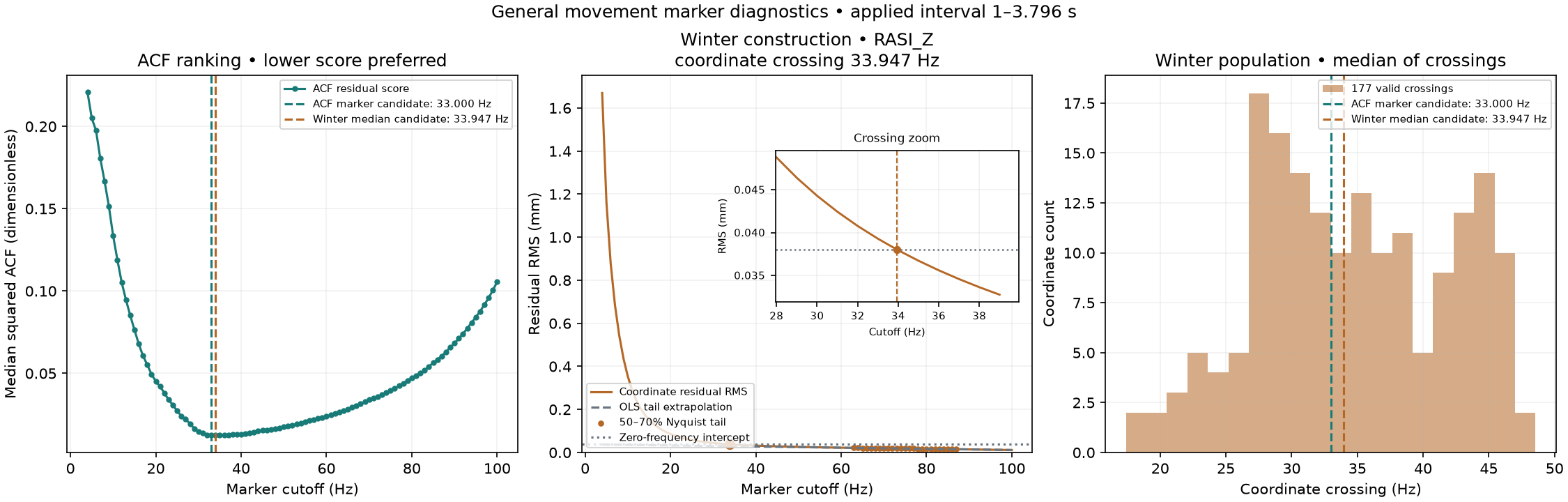
General movement marker diagnostics only; force and joint-moment recommendations unsupported. ACF top-ranked marker candidate: 33 Hz (diagnostic only).
Essential analysis
- Saved public example; separate from your current recording. Rebuilt from the checksum-verified public C3D.
- Applied interval: 1–3.796 s; requested 0–4.796 s. Frequency bounds: 4–100 Hz, step 1 Hz. Full continuous recording filtered before interval extraction.
- ACF ranks marker residual diagnostics within the declared bounds; force and joint-moment recommendations are unsupported.
- The marker winner changes with analysis settings; review its stability.
- Winter marker estimate: 33.9471 Hz (comparison only).
- Joint moments were not calculated for this result.
- The source describes the original C3D trajectories as unfiltered. This is source-reported, not independently established; labeling and Nexus gap processing may have occurred. Review this provenance before interpreting diagnostics of the stored coordinates.
- General movement marker diagnostics only; force and joint-moment recommendations unsupported.
Bounded marker diagnostics on the selected interval; no validated movement-specific cutoff.
Marker evidence
Analysis cautions
- The top-three marker candidate pool is an arbitrary engineering shortlist, not a confidence interval.
- The best marker cutoff changes across time windows or lag choices, so the residual ranking is unstable.
- General movement marker diagnostics only; force and joint-moment recommendations unsupported.
- Residual RMS is the amount removed by filtering, not an estimate of measurement error. A smaller acceleration or smoother curve does not establish accuracy.
- Raw-force peak and impulse preservation are engineering screens. Raw force can contain noise or treadmill resonance; passing does not identify the true force.
- Two-pass Butterworth: order 2 per pass, zero phase; reported cutoffs are the final two-pass −3 dB frequency. Filter continuously before extracting contacts.
- Signal screening alone does not calculate joint moments; any separate experimental moment calculation is reported independently.
- Keep marker and force cutoffs coupled when evaluating inverse dynamics. These separate signal diagnostics do not justify an unmatched cutoff pair.
- Contacts use a fixed raw-force threshold with no smoothing or gap bridging. Inspect event boundaries; both feet are pooled and the selected plate is analysed separately.
- The edge guard is a heuristic, not a proof that all endpoint effects are removed.
- Exact all-zero XYZ marker samples are treated as unavailable even with nonnegative C3D residuals; affected markers are excluded from the signal residual ranking.
Generated directly from calculated results.